Building-Displaying-Sailing - Model Boats and Ships
Boat and Ship Models powered by Sail, Steam or Electric power Scale and Semi-scale, Radio Control Sail Boats.
Dave Mainwaring's Knowledge Network Blog
Dave Mainwaring's Knowledge Network Blog
Select a Radio Controlled Model Sailboat
RC model sailboats are fun for all ages! You can choose your boat from among many alternatives. These range from prebuilt to designing and building your own. Factors to consider include your level of experience, where you plan to sail your boat, how competitive you want to be, and, of course, your budget. Whatever you decide you'll discover a great way to spend time outdoors with family and friends.


The owner is Mike John. Many of you know him from the Duckworks online amateur boatbuilding magazine owned by Chuck and Sandra. This site will help you find the information you need.
The site is about cruising model boats. Not the racing classes, but rather the sort that slowly meanders across a pond rather than race a course
John invites skippers to gather and just have their boats
meandering around in a relaxed way at
Lake Macquarie, Australia.
Model-yacht regattas are very different from the toy-boat matches indulged in by children from one side of a pond to the other. They take place upon sufficiently large bodies of water to allow a course at least a quarter of a mile in length, which is generally sailed twice or three times over to windward and backward. Triangular courses are also sailed. Racing rules correspond generally to those controlling regattas of large boats, and there is full scope to exhibit all the proofs of good seamanship. The yachts are followed in light skiffs, and may not be touched more than a certain number of times during a race, on penalty of a handicap. Racing measurements differ in the various clubs, but all are based upon length and sail-area. In Great Britain the regular Yacht Racing Association rule has been generally adopted, and handicaps deducted from it. In America models are divided into a single schooner with a maximum load water-line of 63 in., and three classes of sloops, the first class including yachts with water-lines between 48 and 53 in., the second class those between 42 and 48 in. and the third and smallest class those between 35 and 42 in. A yacht with a shorter water-line than 35 in. must race in the third class. It has been found that yachts of smaller dimensions possess too little resistance to the wind.
See Model Sailing Yachts; in Marshall's Practical Manuals series, 1905; and How to Build a Model Yacht, by Herbert Fisher (New York, 1902).


Servos are wonderful little devices! Not only do they provide an inexpensive way to activate mechanical linkages through radio control, but they can be hacked to provide inexpensive drive units for small boats and cars with their self-contained motors and electronic speed controls (ESC's), and they can serve as part of a simple on/off power control switch.

A servo is a little gear-motor, ESC, and a position sensing device in one package. Rip the guts out of the case, and you'll have:
a) A lead from the Rx… it carries +5 volts, ground, and a signal wire.
b) A circuit board.
c) A small 5v motor, which may be soldered directly to the circuit board.
d) A pile of gears connecting the motor to the servo output. Bin these.
e) A potentiometer (pot, or variable resistor) connected to the circuit board with 3 leads, and mechanically connected to the servo output.


 Loose parts.
 First trick in hacking a servo: Disconnect the pot from the servo output. Normally, as the pot moves with the servo output, it produces a varying voltage which is read by the circuit board, telling the servo that the output has moved to the desired position (or not). See Schematic 1. When you disconnect this little knob from the gear train and the servo output, leaving it in it's centered position, and then command servo movement at the radio, the circuit board never detects any movement, and thus keeps telling the motor to run.
So now center the stick, servo is happy, goes nowhere; forward stick, and the motor kicks in and just keeps buzzing; reverse stick, ditto the other way. You'll want to put a drop of glue on the pot to keep it from drifting.
Hack 1a: If the Pot itself doesn't suit you, you can replace it with a pair of 2.2k ohm resistors- both tied to the center tap's lead, opposite ends of the resistors to the pot's "outer" leads.

Next hack: The little motors that comes with servos may not suit you… they have tiny little short shafts. Any small 6v toy motor will do instead, as long as you don't load it heavily- the servo's ESC isn't designed to deliver much current! If the motor is connected to the circuit board with wires, no problem to swap them. If the motor is soldered directly to the board, you'll need to work a little more carefully. You can get "solder braid" from Radio Shack- braided copper wire that you heat with a soldering iron while pressing onto the board's soldered joint. The braid sucks up the solder, and you can pull the motor loose much more easily.
If you decide to keep the servo motor, no problem. You can leave the motor on the board- that's what I did on my plastic landing craft. And you can get tiny little plastic u-joints to press onto various miniature shaft sizes, metric and English, from Northwest Shortlines- catalog page at http://www.nwsl.com/Catalog/cat-UJoint.pdf

 |  |
| Servo motor still attached to board. Motor can is pressed into plastic structure. | Twin drive in landing craft. |
 |  |
| Servo motor set in Revell Trawler | Close-up of NWSL U-Joint on servo motor's 1.5mm shaft. "Horn" is sized for 1/16" prop shaft, which is only slightly larger than 1.5mm. |

The Star 45 R/C Model Sail Boat - Builders Journal
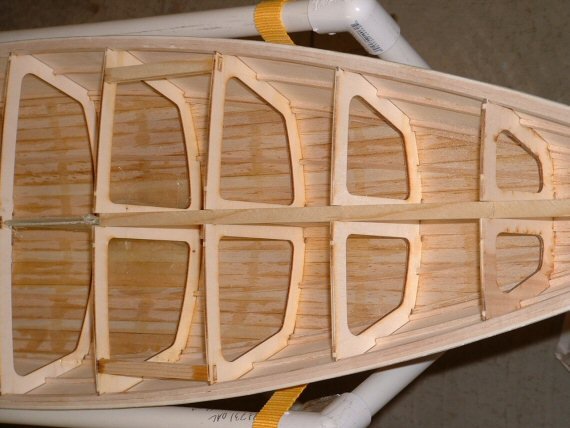
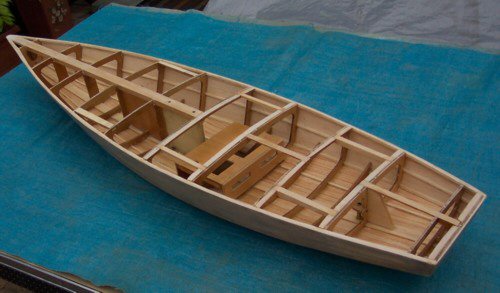
Construction photographs, articles about the Star 45. -- Join the AMYA STAR45 Class discussion group http://groups.yahoo.com/group/Star45/ -- Read about How To Build A Wooden Star45 R/C Sailing Model! Browse http://woodstar45.blogspot.com/ Based on the International Star Boat this semi-scale Star45 can be scratch built by novice or seasoned skipper. Easily radio controlled and large enough to see out on the water this is a classic model model built by hobbyists for over thirty years!


.jpg)
.jpg)
.jpg)
.jpg)



 OR:
OR: